Worked-out solution for the FAU Organic Chemistry “Synthesis of Biodiesel from Canola Oil” experiment. Covers the transesterification of glyceryl trioleate with methanol and sodium hydroxide to produce methyl oleate (biodiesel) and glycerol, including the full procedure, IR spectrum peak assignments, theoretical and actual yields, percent yield calculation, saponification side reaction, and discussion question answers.
Synthesis of Biodiesel from Canola Oil — Lab Handout
Credit: “Biodiesel Synthesis” by John E. Thompson, Lane Community College.
Overview
Biofuels are materials that can be used to produce electrical or mechanical energy. One example of a biofuel is known as biodiesel, which can be produced from vegetable oils, used cooking oil, or algae. Biodiesel is important because it offers a cleaner, renewable, and domestically produced alternative to fossil fuels—helping to address climate change, reduce pollution, support local economies, and move us toward a more sustainable energy future.
Conventional fuel is obtained from the extraction and distillation of crude petroleum that was formed under high temperatures and pressures from the remains of organisms that died millions of years ago. The extraction process can lead to oil spills as well as water contamination. Additionally, crude petroleum contains a high percentage of aromatic compounds. In contrast, biofuels come from oils made by organisms that have lived very recently and do not contain aromatic compounds which are carcinogenic.
Biofuels have some performance advantages compared to conventional petroleum fuel, such as having a higher boiling point and acting as a better lubricant for fuel injection systems. They also emit very low concentrations of sulfur dioxide upon combustion. Biofuels have the potential to reduce carbon emissions because they come from renewable sources like plants, which take up carbon dioxide and incorporate it into their molecular structure through the carbon cycle.
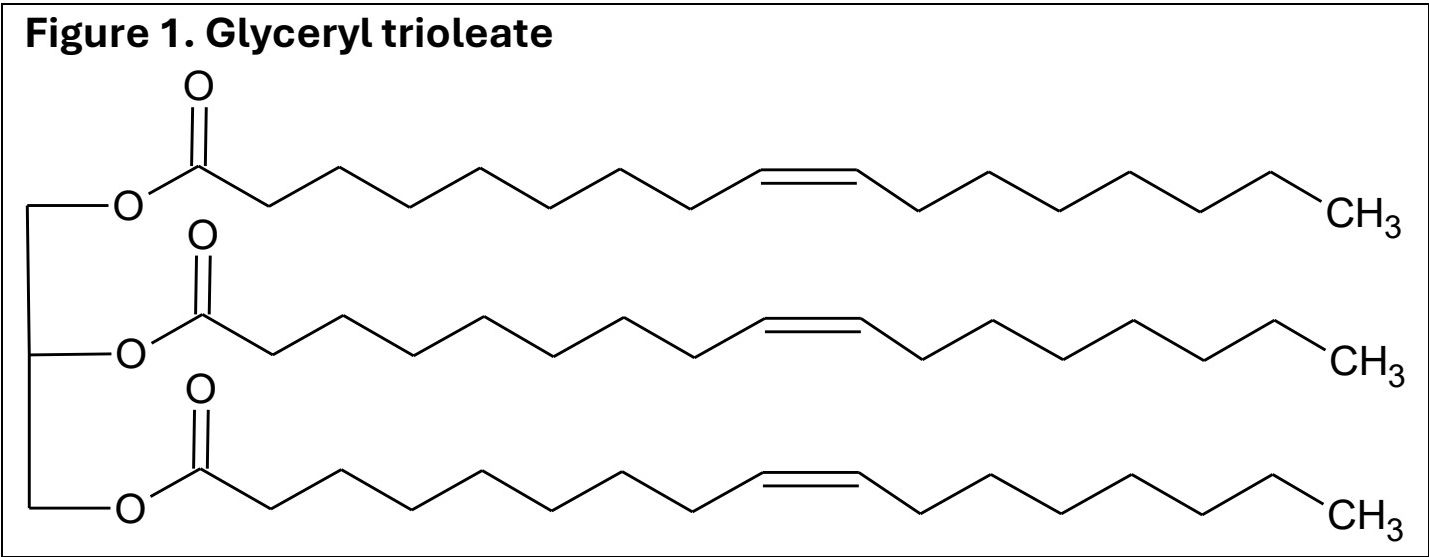
In order to reduce the time and complexity of today’s experiment, you will use refined oil from one source, specifically canola oil. Canola consists of 92% unsaturated fatty acids (that is, they have at least one double bond in their carbon chains). The primary constituent is glyceryl trioleate.
Figure 1. Glyceryl trioleate.
Reaction for producing biodiesel in this lab
This laboratory experiment demonstrates three key green principles: the use of renewable feedstocks, catalysis, and design for degradation. The reaction used in this lab is very similar to the procedure used in making biodiesel on an industrial scale.
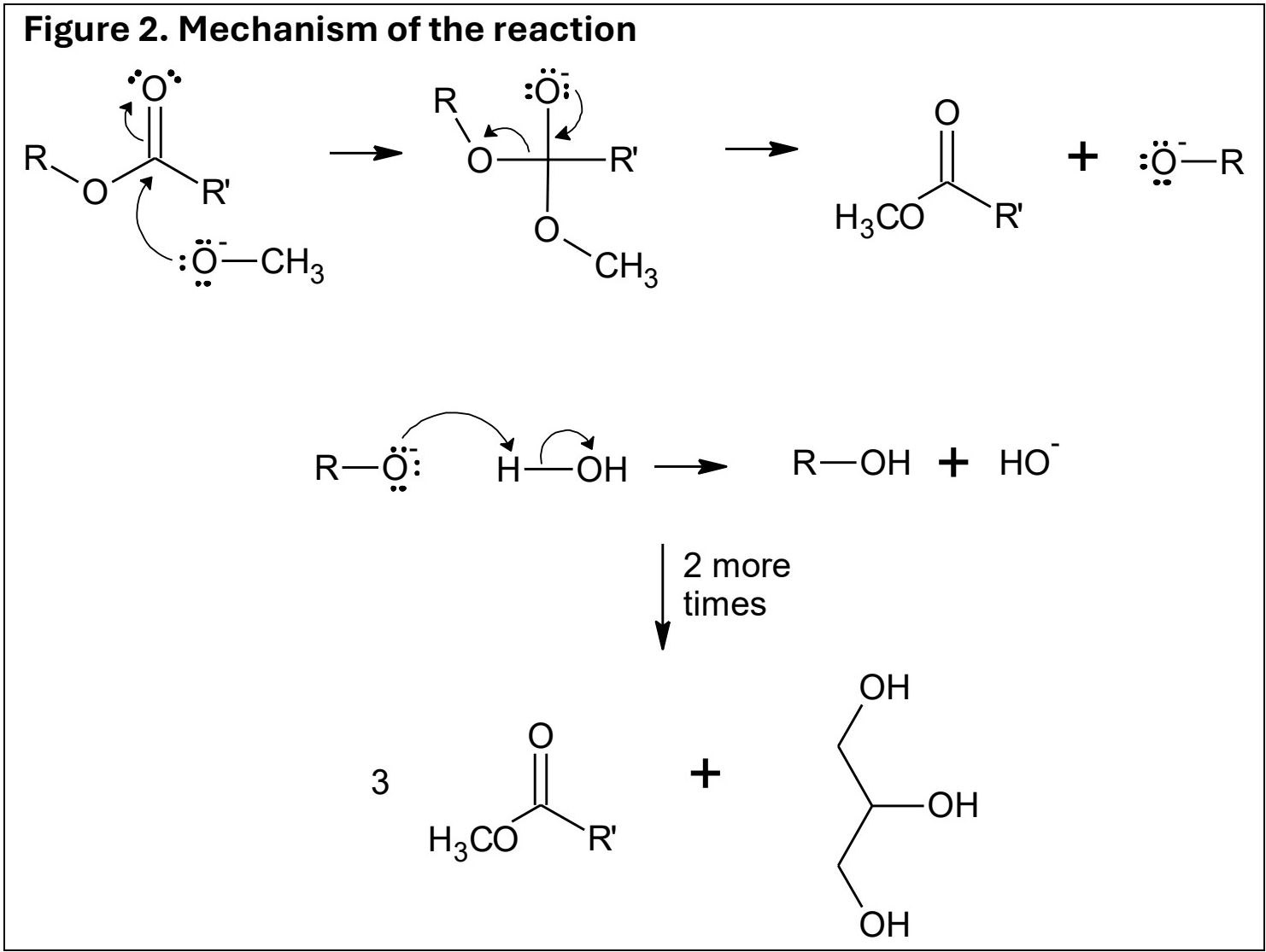
The reaction begins by forming the extremely strong base sodium methoxide when sodium hydroxide is dissolved in methanol (NaOH + CH₃OH → NaOCH₃ + H₂O). Next, vegetable oil (glyceryl trioleate) is added to the mixture, and a methoxide ion (CH₃O⁻) attacks the carbonyl carbon of each ester group through nucleophilic addition. This forms a negatively charged tetrahedral intermediate that then reforms the carbonyl carbon with simultaneous elimination of a glycerol molecule. The remaining alkoxide abstracts a proton from the water molecule that formed in the initial step that created sodium methoxide, reforming a hydroxide ion. Because the net result is a transformation from one ester into a different ester, this is known as a transesterification reaction.
Figure 2. Mechanism of the transesterification reaction.
Chemicals
Sodium hydroxide
Methanol
Vegetable oil (canola oil — glyceryl trioleate)
Procedure
Add 0.2 g of sodium hydroxide to a 125-mL Erlenmeyer flask or 100 mL beaker containing a medium-sized magnetic stir bar. Pour 15 mL of methanol into the flask and stir until dissolved (cover the flask to prevent loss of methanol).
Measure 50 mL of vegetable oil (glyceryl trioleate) and pour this into the sodium-hydroxide–methanol mixture.
Stir the sodium methoxide / vegetable oil mixture at 50 °C for 30 minutes.
Pour the mixture into a 125 mL separatory funnel. Once layers are separated (may take at least 30 minutes), collect each layer in a clean pre-weighed beaker (the top layer should be biodiesel).
Obtain IR spectrum and mass of biodiesel (methyl oleate) produced.
Calculations Mass of vegetable oil used = Density × Volume = 0.91 × 50 = 45.5 g Moles of vegetable oil used = mass / molar mass = 45.5 / 885.43 = 0.051 mol Moles of biodiesel (theoretical) = 0.051 × 3 = 0.153 mol Mass of biodiesel (theoretical yield) = 0.153 × 296.49 = 45.71 g % yield = (mass of student’s biodiesel (top layer) / 45.71) × 100
Completed lab report
Answers blurred
Introduction
The aim of this experiment was to synthesize biodiesels using a process called transesterification which is the replacement of one ester group with another. Vegetable oil, which contains a fat called glyceryl trioleate, was used as the starting material. Biodiesels are fuels derived from renewable sources such as algae, used vegetable oils and animal fats. They are non-toxic, biodegradable and emit lower levels of sulfur dioxide. They also have a lower carbon footprint than fossil fuels because they come from plants which take up CO₂. The vegetable oil used as the starting material consists of a glycerol molecule bonded to three hydrocarbon chains using three ester linkages. These three linkages are broken and replaced by a methoxy group (OCH₃); and the resulting biodiesel is called methyl oleate. The role of methanol in this reaction is to provide the –OCH₃ (methoxy group) that replaces the original ester groups in glyceryl trioleate while NaOH speeds up the reaction by generating the nucleophile (methoxide ion) that attacks the glyceryl trioleate.
Procedure
0.2 g of sodium hydroxide was first added to a 100 mL beaker containing a medium-sized magnetic stir bar.
15 mL of methanol was then poured into the beaker and stirred until dissolved. The beaker was covered to prevent loss of methanol.
50 mL of vegetable oil (glyceryl trioleate) was measured and poured into the sodium-hydroxide-methanol mixture.
The sodium methoxide / vegetable oil mixture was stirred at 50 °C for 30 minutes, then poured into a 125 mL separatory funnel.
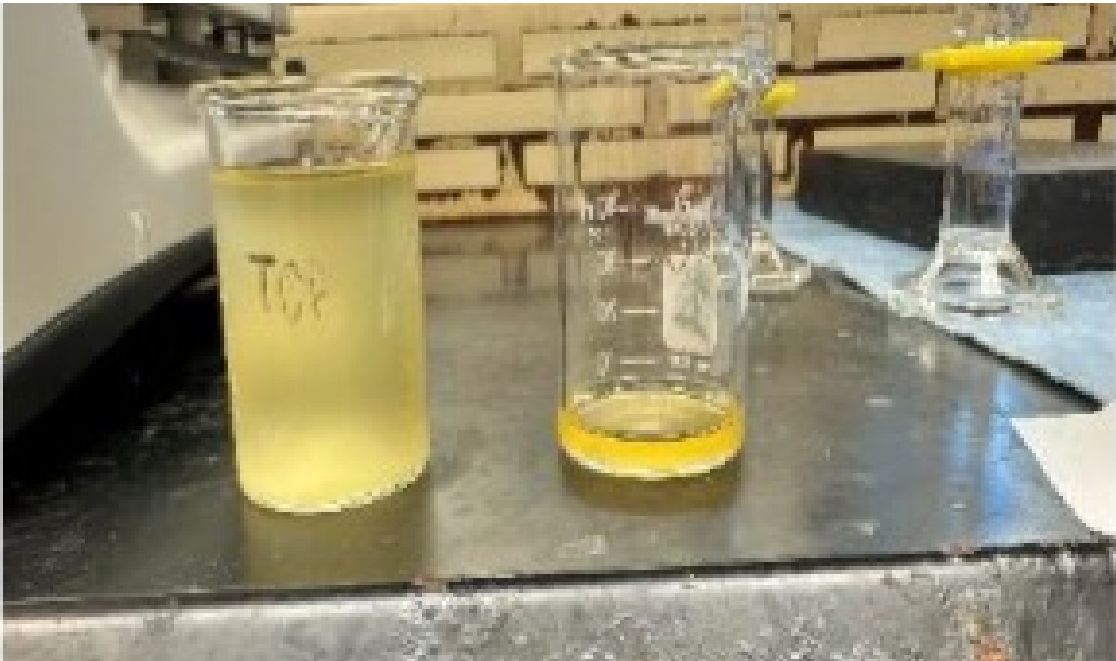
Once layers were separated (at least 30 minutes) each layer was collected in a clean pre-weighed beaker. The top layer was noted to be biodiesel.
IR spectrum and mass of biodiesel (methyl oleate) produced were obtained.
The percent yield was calculated.
Results
Mass of glycerol obtained (bottom layer) Mass = (beaker + glycerol) − (empty beaker) = 69.987 g − 65.37 g = 4.617 g
Mass of biodiesel obtained (top layer) Mass = (beaker + biodiesel) − (empty beaker) = 105.59 g − 63.75 g = 41.84 g
Picture 1: separation of layers.
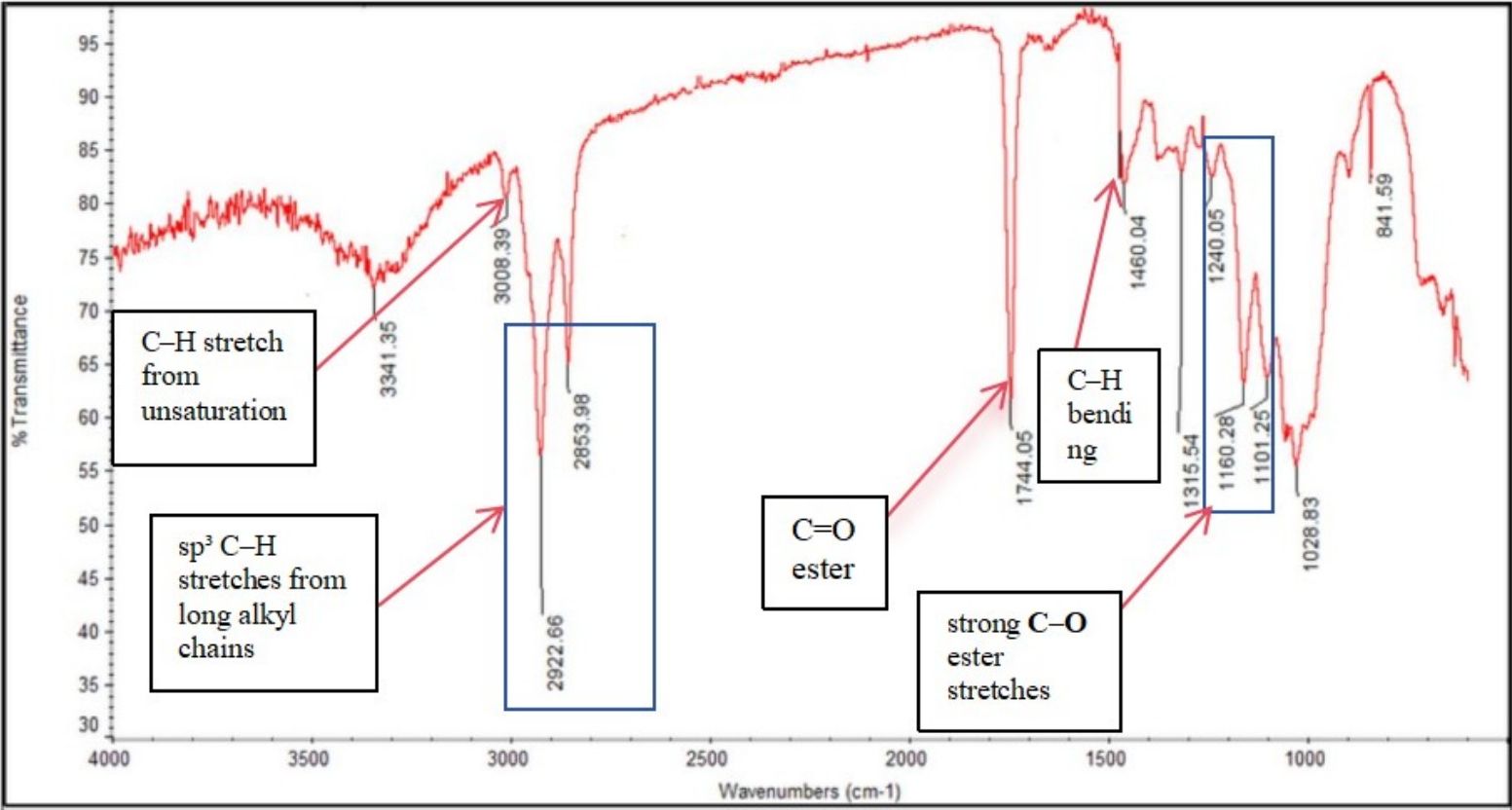
IR Spectrum of Biodiesel
IR spectrum of biodiesel showing characteristic peaks at 3008, 2922, 2854, 1744, 1460, 1315, 1240, 1160, 1101, 1028, and 841 cm⁻¹.
Theoretical & Percent Yield
Mass of vegetable oil used = density × volume = 0.91 g/mL × 50 mL = 45.5 g
Moles of glyceryl trioleate = 45.5 g / 885.43 g/mol = 0.0514 mol
Transesterification of 1 mol glyceryl trioleate yields 3 mol methyl oleate, so theoretical moles of biodiesel = 3 × 0.0514 = 0.1542 mol
Theoretical mass of biodiesel = 0.1542 mol × 296.49 g/mol = 45.71 g
Actual yield of biodiesel = 41.84 g
Percent yield = (41.84 / 45.71) × 100 = 91.53%
Discussion
Sources of error
The sources of error included incomplete reaction (low conversion), incorrect NaOH concentration or moisture contamination, presence of water in reactants, loss of product during transfer, inaccurate measurements, and poor separation of layers. If mixing or heating was insufficient, not all triglycerides converted to biodiesel. NaOH absorbs water from air, forming Na₂CO₃, reducing catalyst effectiveness. Water promotes soap formation (saponification), lowering biodiesel yield.
Improvements
The following could be done to improve the yield of biodiesel: using dry glassware and anhydrous methanol, measuring NaOH quickly and storing it in airtight containers, maintaining constant temperature of approximately 50–60 °C during reaction, stirring thoroughly to ensure complete mixing, using a separatory funnel for cleaner layer separation, allowing sufficient settling time for full phase separation, and performing multiple washes to purify biodiesel.
Possible side reactions
The possible side reaction is saponification (soap formation): Triglyceride + NaOH → Soap + Glycerol. This occurs when water is present and it consumes reactants needed for biodiesel formation. It also produces emulsions that make separation difficult and reduces overall yield.