Worked-out solution for the FAU Organic Chemistry “Nylon Synthesis” experiment. Covers the interfacial condensation polymerization of adipoyl chloride with 1,6-hexanediamine to form nylon-6,6, including the full procedure, nucleophilic acyl substitution mechanism, IR spectrum peak assignments, mass of nylon obtained, and discussion question answers.
Nylon is a group of synthetic organic compounds used in textiles and plastics. They can be classified as condensation polymers, more specifically polyamides. Condensation is a reaction in which two molecules are joined together along with the loss of a small molecule such as water. In this lab experiment, you will be adding adipoyl chloride to 1,6-hexanediamine to make nylon-6,6. The acid chloride and amine react and are joined in a condensation process with loss of the HCl molecule. The product contains a newly formed amide bond. The resulting product has both acid chloride and amine functional groups on the terminal ends that can react with molecules of 1,6-hexanediamine and adipoyl chloride, respectively. This process continues until all the reagents have reacted to form Nylon 6,6 polymer.
Nylon’s unique properties are a result of these strong amide bonds which are highly polar in nature. It is known for its high tensile strength, flexibility, heat and chemical resistance as well as its ability to be easily dyed. What drives the reaction is that the carbonyl carbon of the acyl group in adipoyl chloride is a strong electrophilic (electron poor) center. This is due to the electron-withdrawing effects of the electronegative carbonyl oxygen atom as well as the chlorine it is bonded to which cause the carbonyl carbon to bear a partial positive charge. Additionally, the nitrogen atom of the amine group in 1,6-hexanediamine acts as a strong nucleophile (it is an electron rich center), due to its available lone pair.
Overall reaction for the synthesis of nylon-6,6.
Reaction Mechanism
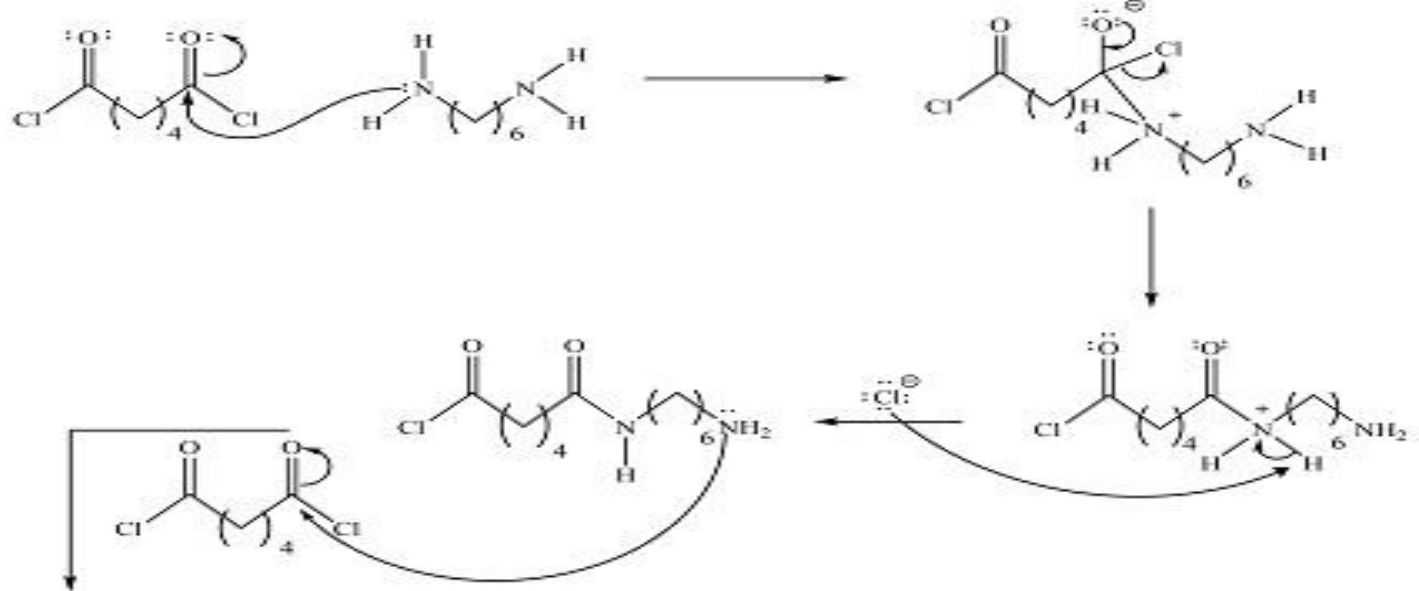
Credit: study.com — step-by-step mechanism for nylon-6,6.
The lone pair on the amine nitrogen of 1,6-hexanediamine attacks the electrophilic carbonyl carbon of adipoyl chloride. This forms a tetrahedral intermediate. The negatively charged oxygen reforms the carbonyl bond and a Cl⁻ ion is kicked out as the C–Cl bond is broken. The Cl⁻ ion then removes a proton from the amine nitrogen, completing the formation of the amide linkage and the process repeats itself.
Chemicals
8 drops or 0.4 mL adipoyl chloride (be cautious when handling!!!)
8 mL cyclohexane (be cautious when handling!!!)
8 drops 25% NaOH
8 mL 5% 1,6-hexanediamine
Procedure
Prepare 2 beakers with the following chemicals:
Beaker A
Beaker B
8 mL cyclohexane
8 mL 1,6-hexanediamine
0.4 mL of adipoyl chloride (8 drops)
8 drops of NaOH
Slowly add solution from Beaker A into Beaker B.
Nylon will form at the interface of the 2 layers.
Use a straw or glass rod to pull the nylon from the interface.
Obtain an IR spectrum using a small piece of your nylon.
Completed Lab Report — Answers (Blurred Preview)
The text below is intentionally blurred. We have the full report ready — message us to unlock it.
Introduction
Nylon is a group of synthetic organic compounds used in textiles and plastics. They can be classified as condensation polymers, more specifically polyamides. Condensation is a reaction in which two molecules are joined together along with the loss of a small molecule such as water. In this lab experiment, adipoyl chloride will be added to 1,6-hexanediamine to make nylon-6,6. The acid chloride and amine react and are joined in a condensation process with loss of the HCl molecule. The product contains a newly formed amide bond. The resulting product has both acid chloride and amine functional groups on the terminal ends that can react with molecules of 1,6-hexanediamine and adipoyl chloride, respectively. This process continues until all the reagents have reacted to form Nylon 6,6 polymer.
Nylon’s unique properties are a result of these strong amide bonds which are highly polar in nature. It is known for its high tensile strength, flexibility, heat and chemical resistance as well as its ability to be easily dyed.
Chemicals and Equipment Used
8 drops or 0.4 mL adipoyl chloride (caution was taken when handling)
8 mL cyclohexane (caution was taken when handling)
8 drops 25% NaOH
8 mL 5% 1,6-hexanediamine
Beakers
Glass rod
IR spectrometer
Analytical balance
Procedure
Beaker A (Organic Phase): 8 mL cyclohexane, 0.4 mL adipoyl chloride.
Beaker B (Aqueous Phase): 8 mL 1,6-hexanediamine, 8 drops NaOH.
The organic solution was slowly poured into the aqueous solution, forming two layers. A thin nylon film formed at the interface. The film was grasped with a glass rod and continuously pulled, forming a fiber. The fiber was rinsed, dried, and weighed. An IR spectrum of the nylon sample was obtained.
Results
Wavenumbers (cm⁻¹)
% Transmittance
4000
~100
3500
~90
3300.10
~70
3000
~92
2932.72
~88
2859.59
~88
2500
~100
2000
~100
1633.18
~38
1536.51
~82
1474.02
~82
1464.19
~82
1416.51
~82
1370.96
~82
1274.95
~82
1188.58
~82
1000
~95
935.01
~95
684.55
~70
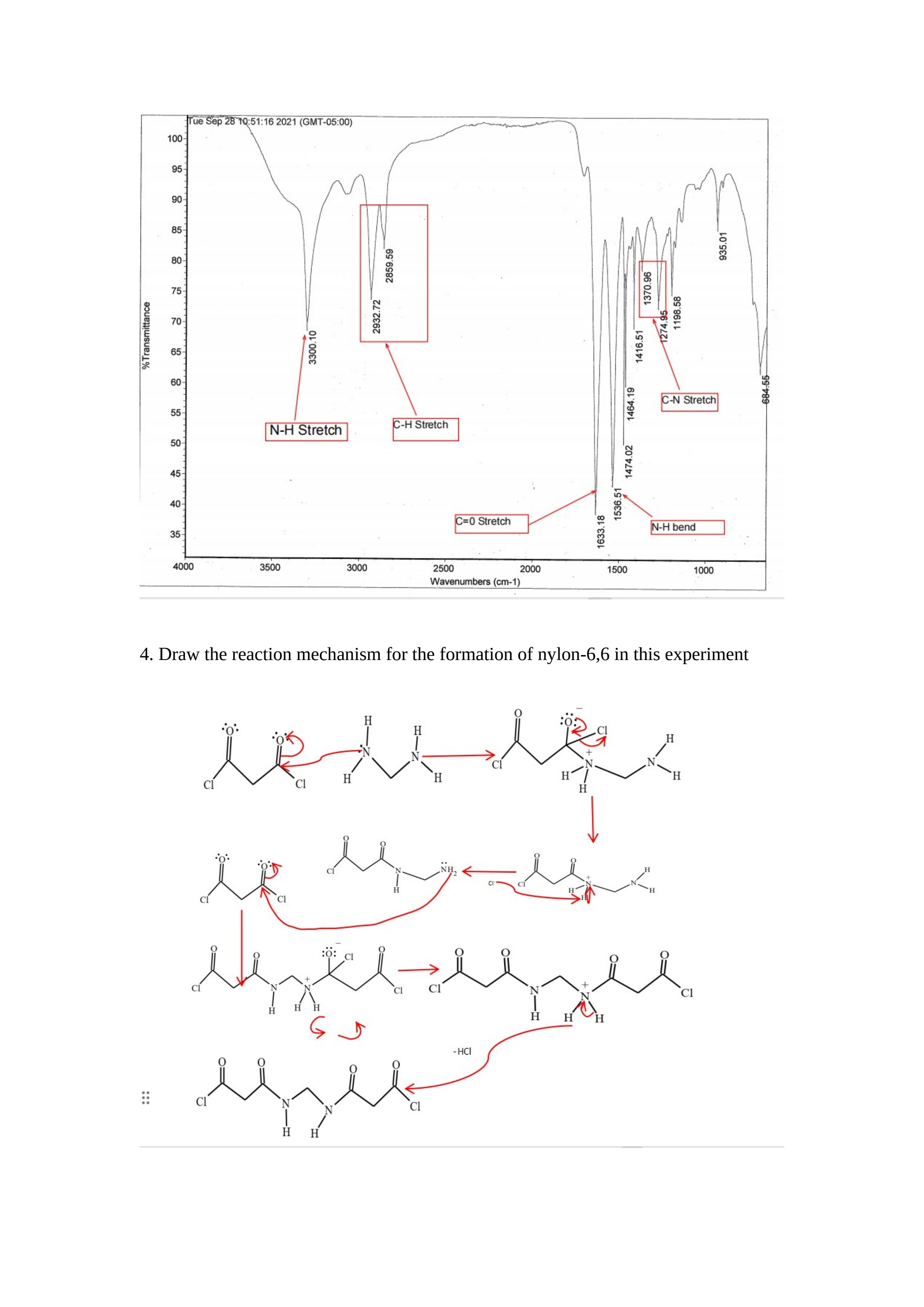
Date: Tue Sep 28 10:51:16 2021 (GMT-05:00). Picture 1: IR spectrum of the nylon sample.
IR spectrum of the nylon-6,6 sample with labeled functional group peaks.
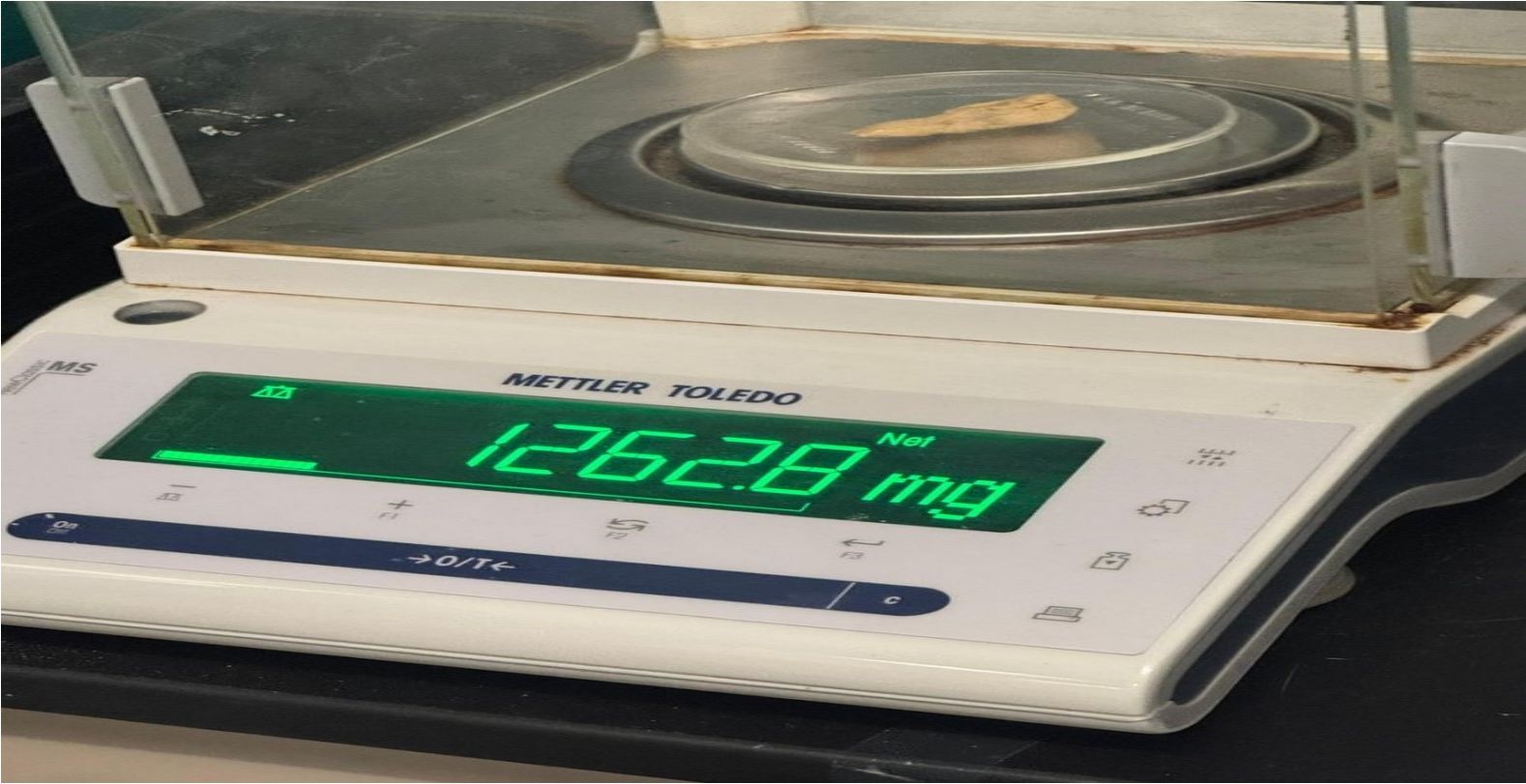
Picture 2: Weighed Nylon Film Obtained — 1262.8 mg = 1.2628 g
Observations
Thin white polymer film formed instantly.
Fiber was strong and flexible.
Table 1: IR Spectrum Analysis
Wavenumber (cm⁻¹)
Functional group
Assignment
~3300
N–H stretch
Amide N–H
~1630–1680
C=O stretch
Amide carbonyl
~1540
N–H bending
Amide II band
~2850–2950
C–H stretch
Alkyl chains
These peaks confirm formation of the amide functional group characteristic of nylon-6,6.
Analysis
The polymer formed via step-growth polymerization at the interface between the organic and aqueous layers. NaOH played a crucial role by neutralizing HCl:
HCl + NaOH → NaCl + H₂O
Without NaOH, HCl would protonate the amine and stop polymerization. The mass of nylon obtained (1.2628 g) indicates successful polymer formation. Yield may be reduced due to hydrolysis of adipoyl chloride by water, incomplete drying, and diffusion limitations at the interface.
Discussion
The experiment successfully demonstrates:
Nucleophilic acyl substitution
Condensation polymerization
Interfacial reaction kinetics
Structure–property relationships
Nylon’s mechanical strength results from strong hydrogen bonding between chains.
Lab Questions
1. Define what a condensation polymer is (2 pts)
A condensation polymer is a polymer formed through a step-growth reaction between monomers that contain two or more functional groups, where each bond formation is accompanied by the elimination of a small molecule such as water (H₂O) or hydrogen chloride (HCl). In condensation polymerization, the monomers join together through repeated condensation reactions, forming long polymer chains while releasing small by-products. In the case of nylon-6,6, the polymer forms when a diamine reacts with a diacid chloride and eliminates HCl during each amide bond formation.
2. What are 4 properties of nylon that make it suitable for use in fabrics and plastics? How are these properties related to its chemical structure? (5 pts)
I. High Tensile Strength — Nylon has strong intermolecular hydrogen bonding between amide groups (–CONH–) along the polymer chain. These hydrogen bonds hold adjacent chains tightly together, increasing mechanical strength and allowing nylon to withstand stretching without breaking.
II. Heat Resistance — The strong hydrogen bonding and partial crystallinity of nylon increase its melting point. The ordered arrangement of polymer chains makes it more thermally stable than many other polymers.
III. Chemical Resistance — The long hydrocarbon segments in nylon’s backbone provide hydrophobic character, making it resistant to many chemicals and solvents. The stable amide linkage also contributes to its durability.
IV. Ability to Be Dyed Easily — Nylon contains polar amide groups that can form hydrogen bonds and dipole interactions with dye molecules, allowing dyes to bind effectively for textile applications.
3. Label the signals in the IR spectrum of nylon that correspond to the main functional groups present.
N–H stretch at 3300.10 cm⁻¹; C–H stretches at 2932.72 and 2859.59 cm⁻¹; C=O stretch at 1633.18 cm⁻¹; N–H bend at 1536.51 cm⁻¹; C–N stretch in the 1274.95–1188.58 cm⁻¹ region.
4. Draw the reaction mechanism for the formation of nylon-6,6 in this experiment.
References
Brown, T. L., LeMay, H. E., et al. Chemistry: The Central Science. Pearson.
Tro, N. J. Chemistry: A Molecular Approach. Pearson.
Carothers, W. H. (1935). Polymerization. Journal of the American Chemical Society.